
Let's start with the thing nobody says out loud
Introducing a toy to someone new feels like defusing a bomb. You're worried they'll feel replaced, inadequate, or like you've been planning this since the second date. You're also worried you'll sound clinical, pushy, or like you've got some elaborate fantasy they're not ready for. Here's what actually happens when you do it right: it becomes one of the most connecting conversations you can have.
I work with couples navigating early intimacy all the time. The ones who bring toys into the relationship early, with honesty and zero pressure, end up with deeper sexual communication and more consistent satisfaction across the board. This isn't accident. It's what happens when you separate desire from shame.
Why new relationships are actually the best time
You might think the opposite. You might think "wait until we really know each other" or "let's establish a baseline first." Here's what research on couples and sexual communication actually shows: the longer you wait to introduce toys, the higher the activation energy required to bring it up. You build an unspoken agreement that sex is a certain way, and breaking that agreement later feels like rewriting the contract.
New relationships have an advantage: the template isn't set yet. You're both still discovering what's normal to you as a couple. If a lemon vibrator enters the picture in the first two or three months, it becomes part of your baseline instead of a deviation from it.
Second advantage: you're both probably already thinking about it. If you're exploring toys, your new partner is too. The silence around it isn't because they don't want to. It's because nobody wants to be the person who brings it up first.
The timing conversation (yes, there's a right way)
Don't do it during sex. Don't do it when you're trying to solve a problem ("we're not connecting" or "I'm not finishing"). Do it when you're both clothed, calm, and have at least 20 minutes to talk without an audience or time pressure.
The best moment is often after you've had good sex, when you're both relaxed and the positive chemistry is fresh. You're not diagnosing a dysfunction. You're saying "this is good, and I want to explore more together."
Start like this: "I've been thinking about trying something together, and I want to run it by you first. No pressure at all, but I'm curious about exploring with a toy. I found this one called a Lem that I think could feel really good for both of us."
Notice what you're doing there: you're naming the tool (removes mystery), you're saying "together" (removes the implication that this is about you), and you're explicitly saying no pressure (gives them room to sit with it without feeling cornered).
What to expect in response
Some partners will be excited immediately. Some will want to think about it. Some will ask clarifying questions. Some will worry about "why now" or "have you been thinking about this the whole time we've been together." All of these are normal.
If they're hesitant, don't sell. Just answer what they ask. "Does this mean I'm not enough?" is a question rooted in insecurity. "No, it means I want to experience pleasure with you in as many ways as possible" is the truthful answer. If they need time, give them time. You can circle back in a week or two.
If they're enthusiastic but nervous about how to use it, that's an opening. You can offer to research together, or you can say "let's figure it out when we get there." The beauty of lemon vibrators is they're intuitive. There's no learning curve.
How to make the first experience feel good for both of you
Don't go into it like you're solving a problem. Go into it like you're playing. You're not performance testing. You're exploring.
Start with your partner in control. Let them hold the toy, touch you with it, decide the speed and pressure. This flips the power dynamic in a way that feels collaborative instead of like they're watching you use a tool on yourself. It also gives them real-time feedback on what feels good, which is data they'll carry into every future experience with you.
Use lube. Even if you don't usually need it, use it. It makes everything feel easier and takes the pressure off the body to produce a certain response right on cue.
Talk about it while it's happening. Not dirty talk necessarily. Just observations. "That feels good." "Try the lower setting." "A bit slower." This turns the whole thing into a conversation instead of a performance.
Don't expect fireworks the first time. Sometimes the hottest part is just the novelty and the intimacy of trying something new together. Sometimes the clitoral vibrator makes you finish faster than expected. Sometimes it takes longer because you're distracted thinking about the fact that you're using a toy. All of that is fine.
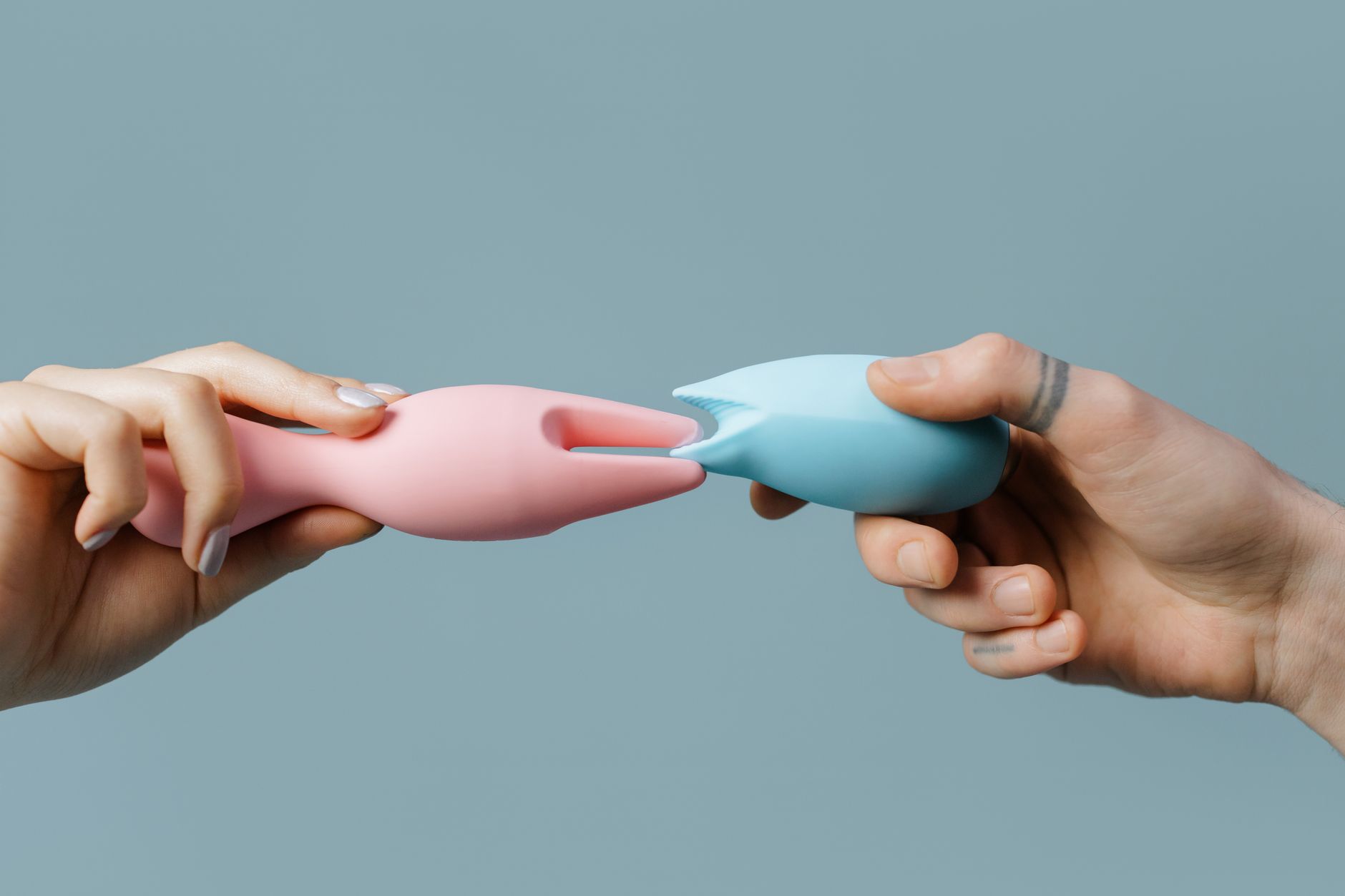
Photo by cottonbro studio on Pexels
What changes after that first time
You've opened a door. You've shown your partner that you trust them with your pleasure. That's enormous. The next time you're together, it's not a big conversation. It's just "want to use the toy tonight?" It becomes part of your sexual toolkit.
Here's what I see happen in my practice: couples who explore toys early report higher communication about pleasure overall. They ask for more things. They feel safer saying "I want this differently." They build a shared language around sex that carries into conversation about other parts of the relationship too.
The toy isn't what creates the intimacy. The honesty is. The fact that you both showed up, vulnerable, willing to try something outside the script. That's the real connection.
When a partner says no (and how to move forward)
If your partner isn't interested, respect that. Pushing turns it into a source of resentment. But you can ask why, gently. Sometimes it's a real boundary. Sometimes it's a misconception (like "toys mean you want someone else"). Sometimes it's just "not right now" and actually means "I need more time."
If it's a core incompatibility (they're completely opposed to toys, and you're someone who wants to explore), that's information worth having early. You get to decide what matters to you in a relationship. But most often, it's negotiable. "What if I use it on my own sometimes, and you don't have to be involved?" "What if we start with something smaller or less intense?" "Can we revisit this in a few months?"
The conversation doesn't end after one "no."
The bigger picture: why this matters
Introducing a lemon vibrator to a new partner isn't just about pleasure. It's a statement. You're saying: my body matters, your pleasure matters, our connection matters more than pretending everything is figured out. You're building a relationship where asking for what you want is normal.
That foundation changes everything that comes after.
People also ask
Will my new partner think I'm weird if I bring up toys?
Most people find it hot. Seriously. The vulnerability of saying "I want to explore pleasure with you" is attractive. What feels weird is silence around desire. If your partner reacts poorly, that's information about whether they're able to talk about sex maturely. Better to know now.
How soon is too soon to mention toys in a new relationship?
After you've had good sex a few times, you've established some sexual chemistry. That's your signal. Some couples do it after the first month. Some after three months. There's no universal timeline. Just wait until you're both relaxed enough to have a real conversation, not panicked or defensive.
What if they want to use a toy on themselves too?
That's wonderful. Encourage it. You'll learn about each other's pleasure, and you can use that knowledge to make partnered experiences better. If you're both exploring your own bodies, you're both bringing more knowledge and confidence into the bedroom.
Is a Lem vibrator good for couples who are just starting out?
Yes. Lemon clitoral vibrators are intuitive, they're built for control, and they have enough intensity variation that they work whether someone's been using toys for years or never has. The Lem specifically has low noise, distinct patterns, and you can share control easily.
What do I do if they're excited but then seems uncomfortable once we actually start?
Pause. Ask what's wrong. Maybe it's physically intense. Maybe it's emotionally weird. Maybe they need a break. This isn't failure. This is the whole point of good communication. You adjust. You try again another time. You build it together.
How do we keep this feeling exciting after the first few times?
Variation. Different positions, different patterns, different times of day. Use it sometimes with a partner, sometimes on your own and have your partner watch. Talk about what you're learning about your body. Treat it as an ongoing conversation, not a one-time event.